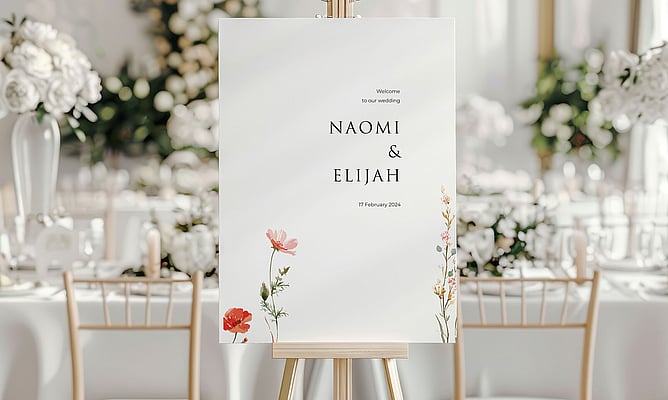
Wedding welcome signs, seating plans, bar menus, unplugged ceremony signs, guestbook signs… the list can get surprisingly long.
And if you’ve spent any time browsing Pinterest for wedding inspiration, you’ve probably seen beautiful signage for just about every part of the day.
But here’s the thing.
You don’t need a sign for everything.
Some wedding signs serve a practical purpose, helping guests find their way or understand what’s happening. Others are beautiful finishing touches that help bring your wedding style together.
The trick is knowing which ones make sense for your day.
So, before you add another sign to your wedding stationery list, let’s look at what’s worth considering, what’s optional and what you can happily skip.
If you’re planning your wedding-day details, explore our personalised wedding menus and place cards to see how thoughtful stationery can bring your table styling together.
Your wedding signage checklist.
Not sure where to start? Here’s a simple checklist of the most common wedding signs and whether you might need them.
Wedding sign | Do you need it? |
|---|---|
Wedding welcome sign | Optional, but lovely for welcoming guests |
Wedding seating plan | Useful if guests have assigned tables |
Directional signs | Helpful for venues with multiple spaces |
Unplugged ceremony sign | Optional if your celebrant makes an announcement |
Bar menu or drinks sign | Useful for signature cocktails or special drinks |
Guestbook sign | Helpful if guests need instructions |
Cards and gifts sign | Optional if the location is obvious |
Order of events sign | Helpful if guests need to know what’s happening next |
Photo-sharing sign | Optional, depending on your plans |
Personalised decorative sign | Entirely a styling choice |
The most useful wedding signage is the kind that makes your guests feel comfortable and helps the day flow naturally.
Everything else is a matter of personal preference.
Planning your wedding stationery?
Do you need a wedding welcome sign?
Let’s start with one of the most popular pieces of wedding signage.
A wedding welcome sign is a lovely way to greet guests and introduce the style of your celebration. It can also help confirm they’re in the right place, particularly if your venue hosts more than one event or has several entrances.
But is it essential?
Not necessarily.
If your ceremony location is obvious, guests are being welcomed by someone on arrival and there’s no confusion about where they need to go, a welcome sign might be more of a styling choice than a practical necessity.
And that’s absolutely fine.
Sometimes we choose things simply because we love them.
If a welcome sign is something you’ve always imagined having, go for it. Just don’t feel you need one because every wedding you’ve saved on Pinterest seems to have one.
Wedding signs that are genuinely useful.
There are a few types of wedding signage that can make a real difference to how smoothly your wedding day runs.
1. WEDDING SEATING PLANS.
If you’re assigning guests to specific tables, a wedding seating plan is one of the more useful signs you can have.
It helps everyone find their place without needing to ask where they’re sitting.
For larger weddings, an alphabetically organised guest list can be easier to navigate than making everyone search through individual table lists.
You can organise your seating plan by guest name or table number, depending on what works best for your celebration.
Just make sure the names are easy to read and that guests have enough space to gather around the display.
If you’re having an informal reception with open seating, however, you may not need a seating plan at all.
2. DIRECTIONAL WEDDING SIGNS.
These are particularly helpful for venues with multiple spaces.
Perhaps your ceremony is in the garden, drinks are being served on the lawn and the reception is in another building.
A few thoughtfully placed directional signs can make the day easier for guests, especially if they haven’t visited the venue before.
They can also be helpful for directing guests towards parking, bathrooms or transport.
On the other hand, if everything is happening in one obvious location, you can probably skip them.
3. SIGNS WITH IMPORTANT INFORMATION.
Some weddings have details guests need to know.
For example:
A request to keep phones away during the ceremony.
Instructions for a guestbook or alternative guest activity.
Transport departure information.
Guidance for a particular part of the celebration.
Information about where guests can share their wedding photographs.
These signs can be useful when the information isn’t obvious or won’t be communicated another way.
But remember, not every instruction needs to become a printed sign. Sometimes your celebrant, MC or venue coordinator can explain things just as easily.
Wedding signs that are lovely, but optional.
These are the pieces that often add personality and atmosphere rather than serving an essential purpose.
BAR MENUS AND DRINKS SIGNS.
If you’re serving signature cocktails, a bar menu can be a lovely addition.
It gives guests a quick overview of what’s available and can tie in beautifully with the rest of your wedding stationery.
You might include your signature cocktails, a selection of wines or a favourite non-alcoholic drink.
But if the bar is straightforward and staff are happy to explain the options, you may not need a separate sign.
UNPLUGGED CEREMONY SIGNS.
If you’d prefer guests to put their phones away during your ceremony, an unplugged ceremony sign can be a gentle reminder.
However, it’s often more effective to have your celebrant make a brief announcement before the ceremony begins.
You can do both, but you don’t necessarily need to.
GUESTBOOK AND CARDS SIGNS.
These can be useful if you’ve created a special guestbook activity or have a designated area for cards and gifts.
For example, you might be asking guests to leave a message on a postcard, sign a piece of artwork or record a video message.
In those situations, a little guidance can be helpful.
But if it’s obvious what guests should do, a sign may simply be repeating information they already understand.
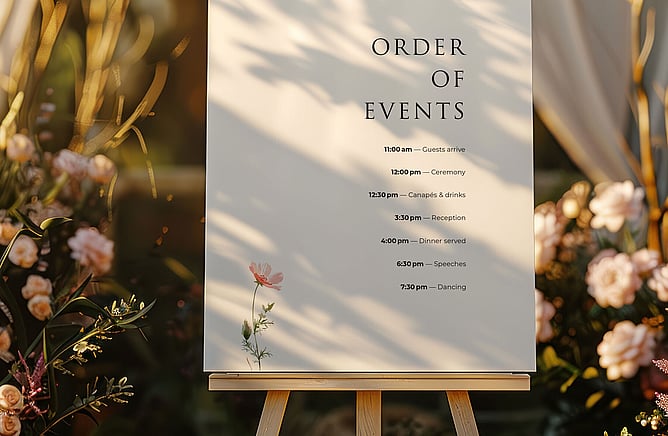
ORDER OF EVENTS SIGNS.
An order of events sign can be helpful when your wedding includes several activities or guests are moving between different spaces.
It gives everyone a general idea of what to expect.
But if your MC or venue team will guide guests throughout the day, a printed schedule may not be necessary.
PERSONALISED WEDDING SIGNS.
A favourite quote, a meaningful phrase or something that reflects your personalities can be a beautiful addition.
These aren’t about necessity. They’re about creating a wedding that feels like you.
And there’s nothing wrong with that.
Just be selective about which details matter most.
Wedding signs you can probably skip.
There are no strict rules here, but I’d think twice about signs that:
Repeat information guests already know.
Explain something that will be obvious when they arrive.
Add another item to organise without improving the guest experience.
Don’t fit naturally with your venue or wedding plans.
You’re only considering because you’ve seen them everywhere online.
You don’t need a sign telling guests to enjoy themselves.
You don’t need a sign explaining where the cake is if the cake is right in front of them.
And you certainly don’t need to fill every empty space at your venue with printed words.
Sometimes less really is more.
How to decide which wedding signs you need.
Before ordering your signage, ask yourself three questions.
1. DOES THIS HELP OUR GUESTS?
Will it make something easier to find, understand or enjoy?
2. DOES IT ADD SOMETHING MEANINGFUL TO OUR WEDDING?
Perhaps it introduces your wedding style, adds personality, or creates a special moment.
3. IS THE INFORMATION ALREADY BEING COMMUNICATED ANOTHER WAY?
If the answer is yes, you might not need another sign.
A good place to start is by walking through your wedding day from a guest’s perspective.
Imagine arriving at the venue, finding the ceremony, moving to drinks and making your way into the reception.
Where might guests need guidance?
Those are the signs worth prioritising.
What size should wedding signs be?
The right size depends on where your sign will be displayed, how much information it contains and how far away guests need to read it.
A welcome sign placed at the entrance to your venue might need to be larger than a small bar menu sitting on a counter.
A seating plan with 120 guest names will need more space than one with 30.
As a general guide:
Welcome signs: Often A2 or A1, depending on the venue and display.
Seating plans: Commonly A2 or A1, depending on guest numbers and layout.
Bar menus: Often A4 or A3 for a tabletop or bar display.
Small information signs: A5 or A4 may be enough for guestbooks, cards or smaller details.
These are starting points rather than fixed rules.
The most important consideration is readability.
A beautifully designed sign isn’t much use if your guests have to stand right in front of it to work out what it says.
Before choosing a size, think about where it will be positioned, how it will be displayed and whether your venue has any requirements.
What materials are best for wedding signage?
There are plenty of options, from printed card and rigid board to acrylic, timber and fabric.
The best choice depends on your wedding style, budget and where the signage will be used.
Printed cardstock can be lovely for smaller signs, particularly when it matches your menus and other wedding stationery.
Rigid printed boards are often a practical option for welcome signs and seating plans.
Acrylic, timber and fabric can create a different look, but they may also require different printing, display and transport arrangements.
For outdoor weddings, it’s especially important to consider wind, weather and how securely your signs will stand.
You don’t need to choose the most expensive material to create something beautiful.
A thoughtfully designed sign, displayed well, can have just as much impact.
When should you order your wedding signage?
Consider your signage alongside the rest of your wedding-day stationery, rather than leaving everything until the final few weeks.
Your welcome sign and directional signage can often be planned earlier because the wording is unlikely to change.
Seating plans, however, usually need to wait until your RSVPs and table arrangements are confirmed.
If you’re having personalised signage designed, allow time for the design process, proofreading, printing and delivery.
It’s also a good idea to check with your venue about display requirements and whether easels or sign holders are available.
The exact timeframe will depend on your designer, the materials you’ve chosen and the complexity of your order.
Making your wedding signage feel cohesive.
Once you’ve decided which signs you need, think about how they work alongside the rest of your wedding stationery.
Your welcome sign, seating plan, menus and place cards don’t need to be identical.
But using consistent typography, colours and design details can help everything feel connected.
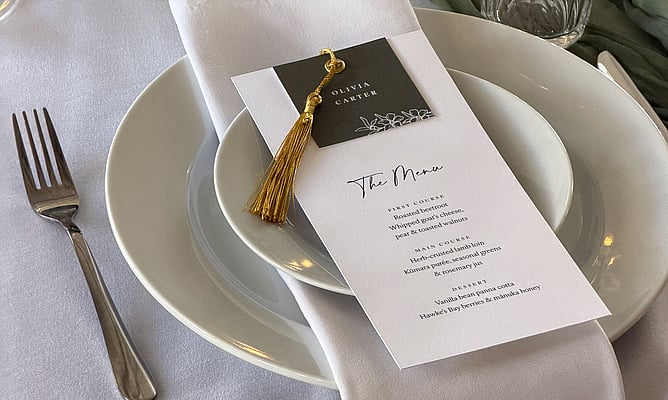
For example, a botanical illustration from your invitations could be carried through to your welcome sign, or a particular typeface could appear across your personalised wedding menus and place cards.
It’s those thoughtful connections that make your wedding stationery feel like part of the overall celebration rather than a collection of unrelated pieces.
And if you’re working with an existing wedding stationery collection, it may be possible to adapt the same design style across your on-the-day stationery.
Frequently asked questions about wedding signage.
WHAT WEDDING SIGNS DO I ACTUALLY NEED?
Most weddings don’t need a long list of signs.
If you’re assigning tables, a seating plan is often one of the most useful. Directional signs can also help if your venue has multiple spaces.
Other signs, including welcome signs, bar menus and guestbook signs, depend on your plans and preferences.
DO I NEED A WELCOME SIGN AT MY WEDDING?
No, a wedding welcome sign isn’t essential.
It can be a lovely way to greet guests and introduce your wedding style, but if your venue is easy to navigate, you can happily skip it.
DO I NEED A SEATING PLAN AND PLACE CARDS?
Not necessarily.
A seating plan tells guests which table they’re sitting at.
Place cards identify individual seats.
If you’re assigning guests to tables but letting them choose their own seats, a seating plan may be enough.
If you’re assigning specific seats, place cards are helpful too.
WHAT'S THE DIFFERENCE BETWEEN A SEATING PLAN AND A SEATING CHART?
The terms are often used interchangeably in wedding planning.
Both generally refer to a display that helps guests find their assigned tables or seats.
In New Zealand, wedding seating plan is a common term, while wedding seating chart is also widely used online.
SHOULD WEDDING SIGNS MATCH THE INVITATIONS?
They don’t have to match exactly, but a few shared design elements can create a lovely sense of continuity.
Using similar typography, colours, or illustrations helps your wedding stationery feel considered and cohesive.
HOW MANY WEDDING SIGNS ARE TOO MANY?
There’s no magic number.
If a sign helps your guests or adds something meaningful to your celebration, it has a purpose.
If you’re adding it simply because you’ve seen it at other weddings, it might be worth reconsidering.
CAN I HAVE WEDDING SIGNAGE WITHOUT A FULL MATCHING STATIONERY SUITE?
Absolutely.
You can choose individual pieces that complement your wedding style without needing an entire matching collection.
A welcome sign, seating plan or bar menu can work beautifully on its own.
CAN WEDDING SIGNS BE USED OUTDOORS?
Yes, but the material and display method matter.
Consider the weather, wind and ground conditions, and make sure any easels or stands are stable.
Check with your signage supplier about suitable materials for outdoor use.
WHO SETS UP THE WEDDING SIGNS ON THE DAY?
This depends on your venue and suppliers.
Some venues or wedding coordinators will position signage as part of the setup, while others may ask you to arrange it.
It’s worth confirming who is responsible, particularly for larger seating plans and welcome signs that require easels or stands.
CAN I REUSE MY WEDDING SIGNS AFTER THE WEDDING?
Some signs can make lovely keepsakes, particularly personalised welcome signs or signs featuring meaningful wording.
You could also choose a design without a date if you’d like to display it at home afterwards.
For signs that are purely practical, consider whether you could hire a display or choose a recyclable material instead.
So, which wedding signs do you really need?
The answer depends on your wedding.
A large celebration at a venue with several different spaces will have different signage needs than an intimate wedding in one location.
Start with the signs that help your guests.
Then add the pieces you genuinely love.
And leave the rest.
Your wedding doesn’t need more signs. It needs the right signs for your day.
Need help planning your wedding stationery?
If you’re still working out what you need and when to organise it, download my free Wedding Stationery Checklist & Timeline.
It’s designed to help you plan your stationery without overlooking the important details.
Download the Wedding Stationery Checklist & Timeline
Or explore Poppyseed Design’s wedding stationery collections and individual pieces, from personalised wedding menus and place cards to invitations and thoughtful finishing touches.
Planning something a little more personal? I’d love to hear what you’re imagining.
Written by Amy Brailey
Founder & Wedding Stationery Designer, Poppyseed Design
Amy Brailey is the designer behind Poppyseed Design, creating thoughtfully considered wedding invitations, personalised stationery and beautiful wedding-day details for couples across New Zealand.
With a love for meaningful design and the little details that make a celebration feel personal, Amy shares practical advice and inspiration to help couples plan their wedding stationery with confidence.